
St. Louis County Jail Mugshots Overview
The official St. Louis County roster is not presented as a mugshot gallery. It is a PDF roster that shows names, booking numbers, booking dates, date of birth or age, location, bail, arresting agency, charges, offense level, order type, and projected release date when present. No booking photograph was observed in official PDF roster snippets reviewed for the research, and the sheriff's jail roster page does not advertise a current jail mugshot gallery.
This distinction changes the search path. A person looking for St. Louis County jail mugshots should first confirm the booking through the roster, then use the sheriff's public data process for a booking photo if the photo is not posted online. The public offender records page links to Most Wanted, MNDOC offenders, Minnesota Courts, Minnesota Criminal History, sex-offender resources, and VINELink. It does not provide a local mugshot feed.
Find St. Louis County Booking Photos
The roster still matters because it gives the identifiers needed for a photo request. Name alone can be too vague. A better request includes the booking number, booking date, incident or case number if known, arresting agency, and a clear statement that the requested record is a booking photograph connected to a jail booking. If the person is not listed, check the intake delay, 48-hour release roster, transfer location, state DOC, BOP, and ICE custody paths before assuming no booking occurred.
- Open the official jail roster page and search the current PDF or 48-hour release PDF by name.
- Record the booking number, booking date, location, arresting agency, and charge text if the person appears.
- Check official Most Wanted or sheriff news only when the issue is a warrant or public-safety matter.
- Use the sheriff's public data request process for a booking photo that is not posted in the PDF roster.
- Ask Central Records to classify and release the photo if it is public under Minnesota Data Practices law.
The roster landing page source is the official St. Louis County jail roster page.
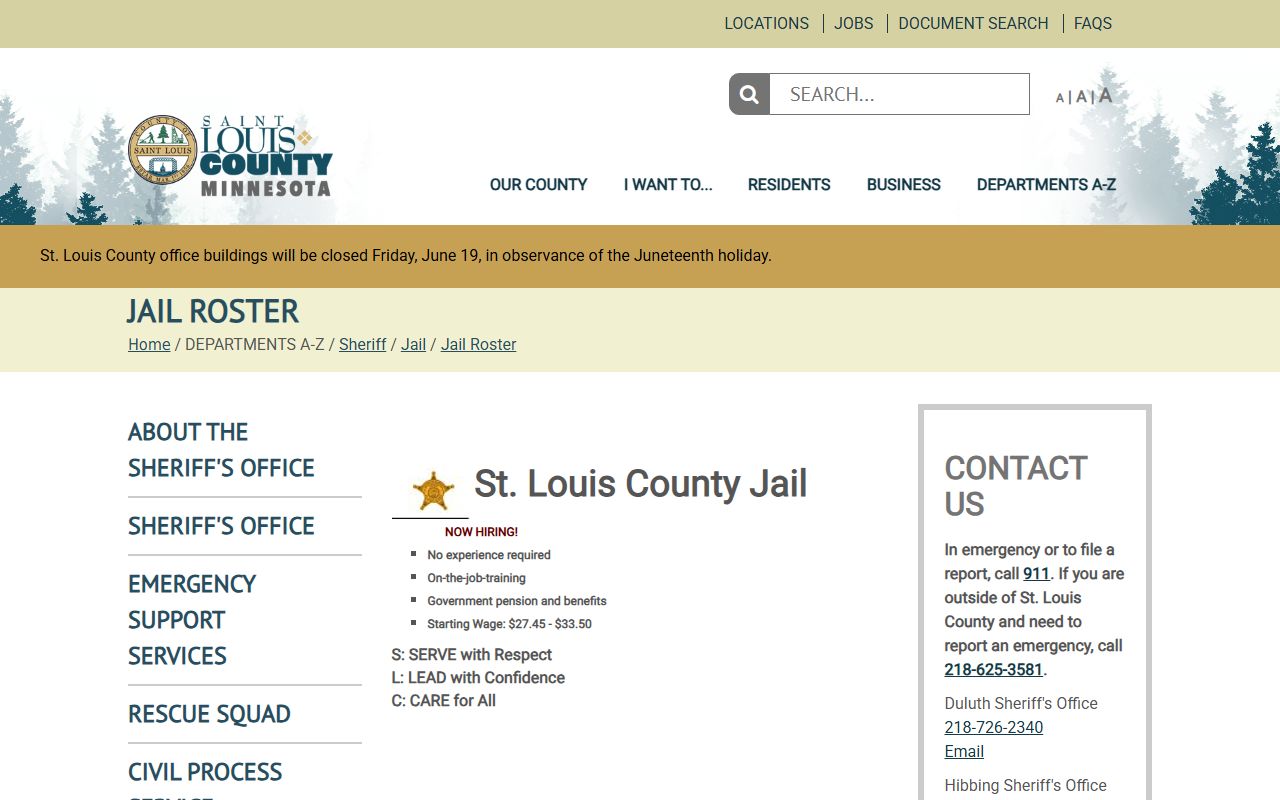
The roster page is useful for mugshot work because it points to the custody PDFs that supply the identifying data for a later records request.
St. Louis County Booking Record Fields
A booking photo request should be tied to the actual jail record fields. The official PDF roster is the starting point because it shows enough custody data to distinguish one person from another. It does not show a housing unit or pod in the snippets reviewed, and it did not show court dates. Court status is handled through Minnesota Court Records Online after the court case is filed.
| Field | What It Shows |
|---|---|
| Booking photo | No mugshot was observed in official PDF roster snippets; request through public data if needed. |
| Name | Full name used to locate the booking record. |
| Booking number | Numeric jail identifier assigned during booking. |
| Booking date/time | Date and time tied to the jail booking. |
| DOB / age | Identity check that helps avoid wrong-person matches. |
| Charges | Booking charge text, often abbreviated and subject to later court changes. |
| Arresting agency | Agency connected to the arrest, hold, warrant, or booking. |
| Location | Facility-level location, including transfer locations when used. |
Are St. Louis County Mugshots Public
Minnesota law generally treats booking photographs as public law-enforcement data unless an exception applies. The sheriff's roster disclaimer cites Minnesota Statutes sections 13.82, 13.85, and 641.05. Section 13.82 governs law-enforcement data, including arrest-related data and booking-photo classification. Section 13.85 covers corrections and detention data created, collected, used, or maintained because of lawful confinement or detainment in jails, lockups, work farms, prisons, and other detention facilities.
Key statutes:
Minn. Stat. section 13.82 governs law-enforcement data and is the main booking-photo classification statute.
Minn. Stat. section 13.85 defines corrections and detention data for jail, lockup, work-farm, prison, and other detention records.
Minn. Stat. section 641.05 requires sheriffs to maintain permanent jail commitment records.
What St. Louis County Releases
The public rule does not mean every image is instantly online or released without review. The Records Division classifies records under Minnesota Data Practices guidelines. Juvenile information is restricted. Active investigative data may be withheld or redacted. A photo tied to a current investigation, a juvenile matter, a protected person, or another restricted category may not be released in the same way as an ordinary adult booking photo.
What is and isn't public: The roster is public custody data, but it did not show booking photos in reviewed snippets. A requested photo may be released, redacted, or withheld after the sheriff's records review.
Request St. Louis County Booking Photo
Use the St. Louis County Sheriff's Office public data request process for a booking photo that is not online. Requests go through Central Records Division at the Duluth Court House, 100 N 5th Ave W, Room 103, Duluth, MN 55802. The phone number is 218-726-2340, the email address is DSO.Records@StLouisCountyMN.gov, and the fax number from the form is 218-726-2171. The form may be returned in person, by mail, by email, or by fax.
Be specific. Include the person's full name, booking number if known, booking date, incident or case number if known, incident date, incident address, involved parties, and a short description of the data requested. If the request is for a booking photograph, say that clearly. The form includes delivery choices such as email PDF copy or in-person inspection. Body-worn-camera requests must use the appropriate BWC form, so do not mix BWC footage into a simple booking-photo request.
The records request source in the manifest is the county's public data request page.
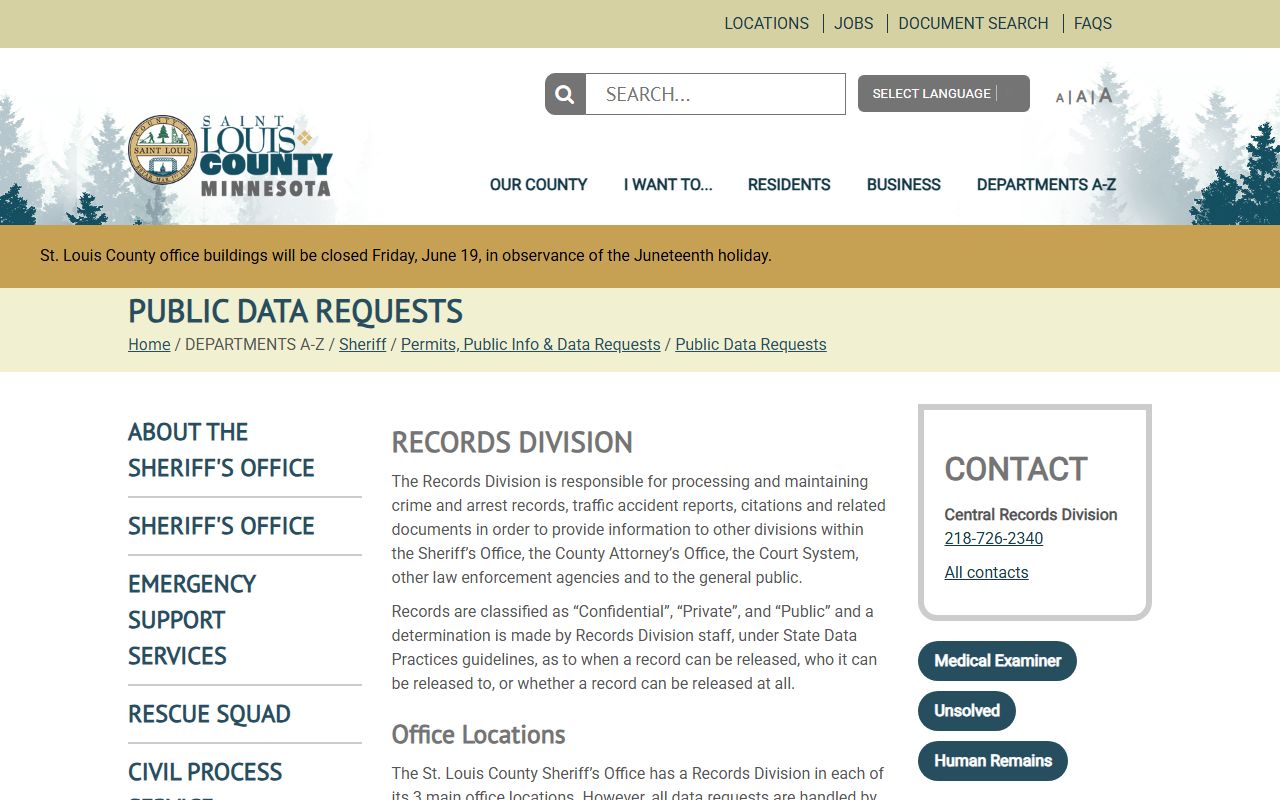
The Records Division route is the official path when the roster confirms a booking but does not publish a mugshot.
How Long Mugshots Stay Public
The research did not locate an official St. Louis County retention window for online booking photos because the official PDF roster did not show booking photos. The county does publish a current roster and a 48-hour release roster. That means a person may move out of the current custody PDF after release while still appearing on the release roster for the recent window. Historical booking records and photographs, if releasable, are handled through public data requests rather than a long-term public mugshot archive.
A booking photo is not the same as a conviction record. It is created at booking. If a court later dismisses the case, amends charges, or seals a record, the correct route is through the court record and public data process, not a commercial removal demand. For the court side of that process, review court records after a St. Louis County jail arrest.
Juvenile Mugshots and Redactions
Arrowhead Juvenile Center is in St. Louis County, but it serves court-ordered youth on delinquency files and is not an adult jail roster facility. Juvenile information is restricted by Minnesota law, and youth records should not be treated like adult jail roster records. Redactions may also apply to active investigative data, private data, confidential data, medical information, protected victim or witness information, and other material classified by law.
For adult jail records, the sheriff's Central Records staff decides whether a booking photo is public, private, confidential, redacted, or not releasable. The requester should not assume a denial means no arrest occurred. It may mean the requested image is restricted, not located from the identifiers provided, or tied to a category that requires a different form or court order.
Most Wanted vs Jail Mugshots
Most Wanted material is not the same thing as a jail mugshot roster. St. Louis County's public offender records page links to Most Wanted, state criminal history, Minnesota Courts, MNDOC offenders, sex-offender resources, and VINELink. The sheriff's warrant page publishes active felony and misdemeanor warrant PDFs, and the county offers an online warrant-tip form. Those tools are for warrants, public safety, and records routing. They should not be used as a substitute for the official jail roster or a booking-photo records request.
A name on a warrant list does not mean guilt. The warrant page states that a warrant is a court order to apprehend someone and that the Sheriff's Office does not issue warrants. It also says warrant data must be confirmed before enforcement. Booking photos, warrant photos, and court records each have a different source and purpose.
Federal and State Booking Photos
Federal custody is separate. The St. Louis County jail may hold U.S. Marshals prisoners locally, but that does not make the jail a BOP prison. If a federal defendant is held in the county jail, the county roster may show the person as local custody. Once a person is in BOP custody, use the BOP inmate locator. Federal systems generally do not provide county-style booking mugshots for public lookup.
State prison custody is also separate. The MNDOC Locator covers adults committed to the Commissioner of Corrections who are still under DOC jurisdiction. It is used for prison and supervision records, not the county's current jail mugshot or booking-photo request process. ICE ODLS is separate again and searches current ICE custody or CBP custody over 48 hours.
Mugshot Removal and Sealed Records
Do not use nonofficial photo-publishing sites as the source of truth for St. Louis County records. The official sources are the sheriff, court, MNDOC, BOP, ICE, or another government office that created the record. If a case is dismissed, sealed, or expunged, the public-record question should be handled through Minnesota court procedures and the agency that maintains the data. Minnesota Statutes chapter 609A governs expungement and sealing eligibility. The sheriff's Records Division may need the court order or specific case details to classify a request or correction.
For a correction, use exact identifiers and state what is wrong: wrong person, wrong date, outdated custody status, sealed court record, or a photo tied to a restricted case. A records request is not legal advice, and the sheriff's staff cannot erase a court case. Court sealing and jail-data classification are related, but they are not the same step.