
St. Louis County Court Records After Arrest
After a St. Louis County jail arrest, the first public record may be the jail roster. That record is about custody. The court record begins when a case is opened in Minnesota district court after review by prosecutors and court staff. The St. Louis County Attorney's Office prosecutes crimes that occur in the county, including felonies, gross misdemeanors, misdemeanors, certain petty misdemeanors, ordinance violations, and juvenile matters. The Criminal Division has prosecutors in Duluth, Virginia, and Hibbing courthouse offices.
Booking charges are not final court charges. The jail roster reflects what was entered at booking or as a hold. A prosecutor may file a different charge, amend a count, decline a count, dismiss a count, or add a count after review. For custody and booking detail, use St. Louis County jail inmate records. For booking-photo questions, use the St. Louis County jail mugshots page. Court records after arrest are about the filed case, hearings, charge status, warrants, bail orders, and final disposition.
Find St. Louis County Court Records
Minnesota Court Records Online, often called MCRO, is the statewide public case search. Use MCRO Case Search for court records after a St. Louis County arrest. Search by defendant name when the case number is unknown, or use the case number if it appears on a notice, warrant, complaint, attorney document, or court record. Filter to St. Louis County or the Sixth Judicial District when available.
- Open MCRO Case Search and complete any required acknowledgment or disclaimer step.
- Search by defendant name, or use the case number if it is known from a court paper or attorney notice.
- Limit the location to St. Louis County or the Sixth Judicial District when the portal offers that filter.
- Open the case and review the charge list, charge level, current status, hearings, orders, and disposition.
- If the case is not online or the document is older, use courthouse public-access terminals or contact court administration.
The MCRO source in the manifest is the Minnesota Court Records Online case-search page.
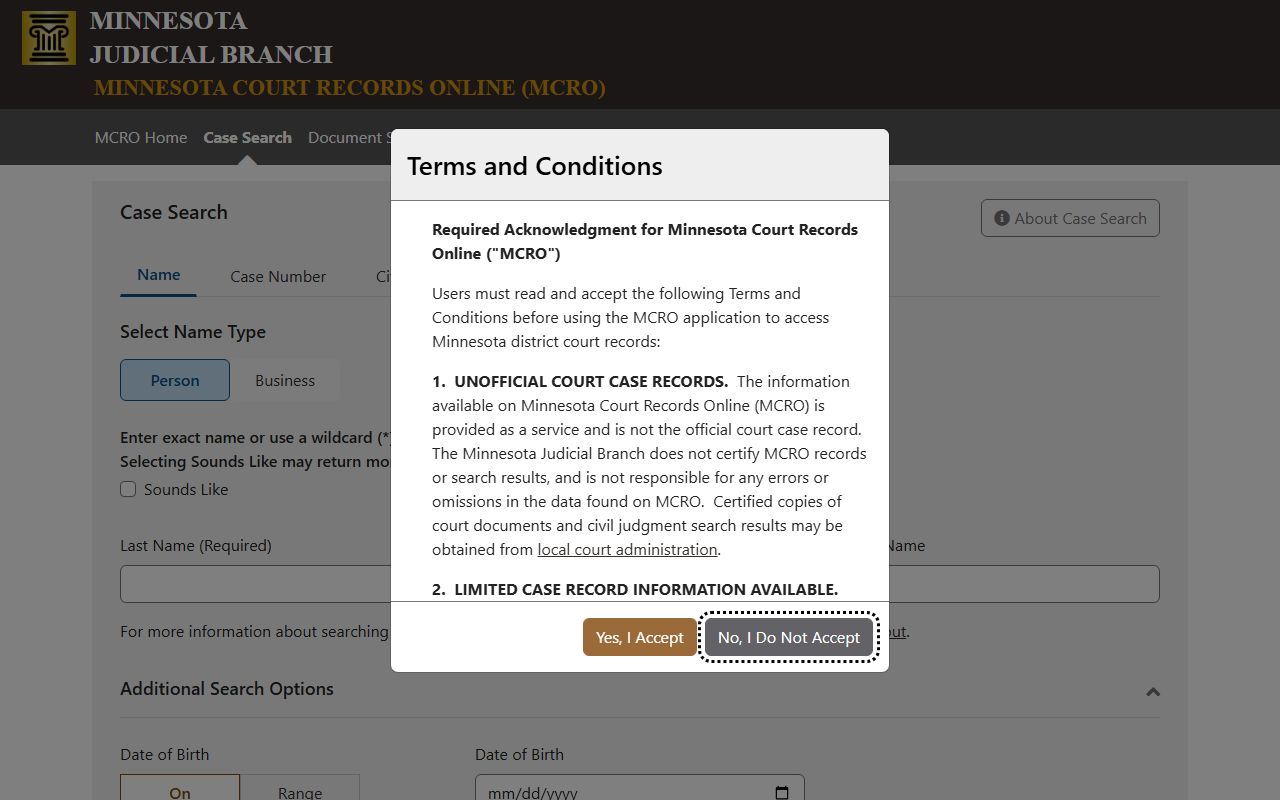
MCRO is the court-record path. The jail roster remains the custody path for a person who is still in the St. Louis County jail system.
St. Louis County Court Search Fields
MCRO is statewide, so the same portal can show cases from many Minnesota counties. Narrow the search with a name, case number, and county or location filter when the search screen provides it. The Judicial Branch warns that MCRO should not be used for background checks and directs formal public criminal-history checks to the BCA Minnesota Public Criminal History Search system.
| Field Label | Type | Required | Options / Format Notes |
|---|---|---|---|
| Case Search | Web search | Yes | Public statewide court-record search. |
| Name | Text | Depends on search type | Search by party or defendant name where available. |
| Case number | Text | Optional or alternate | Best if known from a court notice, warrant, complaint, or attorney. |
| County/location | Filter | Optional | Use St. Louis County or Sixth Judicial District where available. |
| Disclaimer/acknowledgment | Checkbox or button | May be required | MCRO warns it should not be used for background checks. |
Charges Filed After a Jail Arrest
A charging document is the formal paper or filing that starts or defines the criminal case in court. In St. Louis County, the County Attorney's Office reviews criminal matters and files charges within its authority. The research identifies criminal prosecution authority for felony, gross misdemeanor, misdemeanor, petty misdemeanor, ordinance, and juvenile matters. The exact charging document depends on the case type and court process.
| Document | Typical Role | What to Check |
|---|---|---|
| Complaint | Common charging document for many Minnesota criminal cases. | Counts, facts alleged, statute citations, bail or release requests. |
| Information | Prosecutor-filed charging document used in some criminal procedures. | Filed counts and any amended charge language. |
| Indictment | Grand-jury charging document for certain serious cases. | Indicted counts, offense level, and next hearing. |
Charge Status After St. Louis County Arrest
The charge status shows where a count stands in court. A charge is an accusation, not a conviction. The jail roster may list one charge text at booking, while MCRO may later show a filed complaint with more detailed counts or different language. Check each count separately because one count may be dismissed while another remains pending or resolves by plea.
| Status | What It Means |
|---|---|
| Pending | The charge is active and has not been finally resolved. |
| Amended | The prosecutor or court record changed the charge language, level, or count. |
| Dismissed | The charge was dropped by court order or prosecutorial action. |
| Convicted | The charge resulted in a guilty plea, verdict, or other conviction entry. |
| Acquitted | The person was found not guilty on that count. |
Bond and Release After Arrest
Bond is part of the court and custody path. The county bail page defines a bail bond as a written promise used to obtain release of a defendant awaiting trial. It says a defendant, family member, friend, or professional bail agent may execute a bond promising forfeiture of the court-set amount if the defendant fails to return. The county page says bail agents may charge a nonrefundable fee of 10 to 20 percent of the bail amount.
| Bond Type | How It Works in the St. Louis County Path |
|---|---|
| Cash bail or bond | Money is paid to satisfy a court-set release amount. |
| Surety or bail agent | A bail agent posts bond and charges a nonrefundable fee noted by the county page. |
| No bail | The roster may show no releasable bail amount. |
| Hold or remand | A court order, warrant, sentence, or other agency hold may block release. |
| DOC or other-agency hold | Another sentence, agency, or supervision matter must be resolved. |
The county bail source appears in the manifest as the St. Louis County bail bonds page.
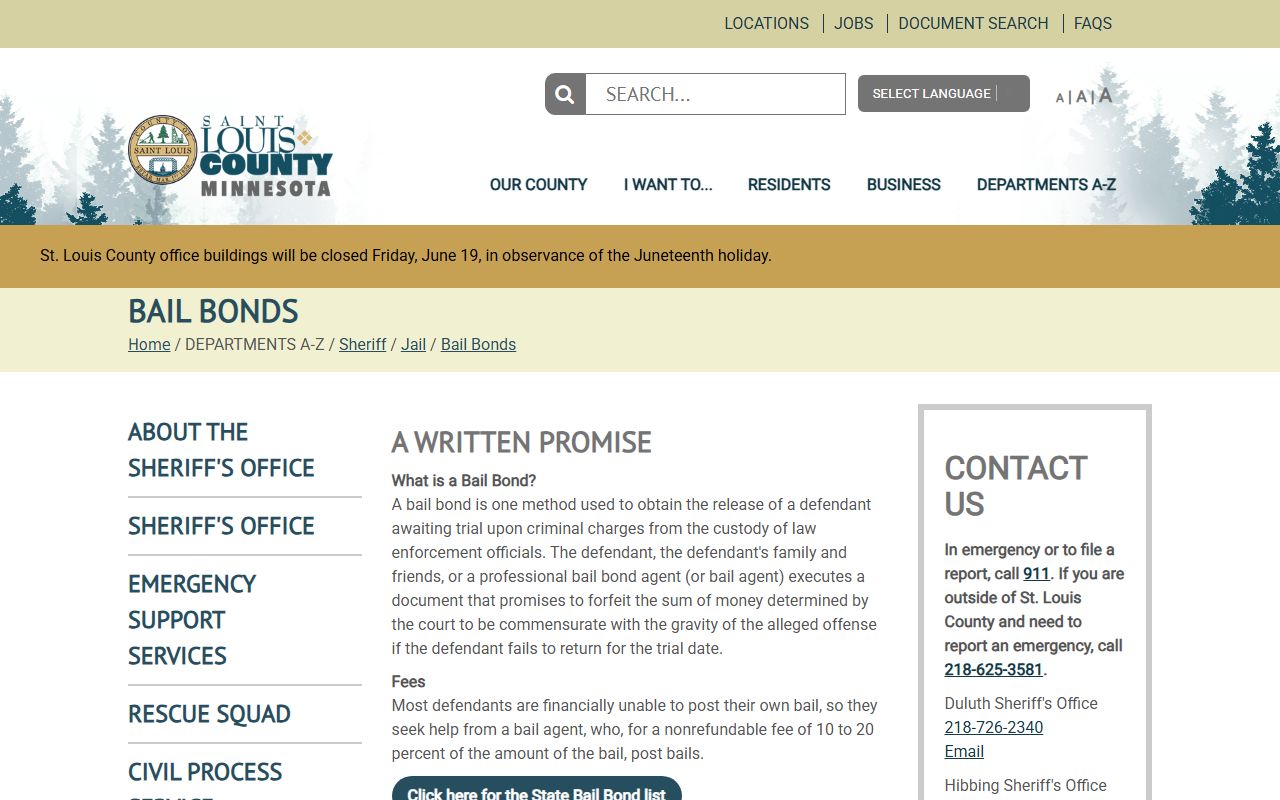
The bail page helps connect the jail roster bail field with the court order that controls release.
Warrants Before St. Louis County Arrest
The sheriff's Warrant Division processes and maintains current warrant data, but the Sheriff's Office does not issue warrants. Warrants are court orders signed by judges and entered into statewide and national databases. St. Louis County publishes active felony and active misdemeanor warrant PDFs as a public service, with information from the Sixth Judicial District Court. The warrant page says the lists update at 9:00 PM seven days a week, but also warns that delays can occur and all active warrants must be confirmed before enforcement.
For warrant resolution, the page gives specific courthouse instructions. Duluth cases use Tuesday mornings at 8:30 AM, room 133, to be added to the court calendar. Hibbing Court Administration is 218-274-6007, option 4. Virginia Court Administration is 218-305-7021, option 4. Do not attempt to apprehend a person on the list. Law enforcement handles arrests.
Charges vs Convictions
Court records after an arrest must be read with this distinction in mind. A charge is an allegation filed in court. A conviction is a legal outcome after a plea, verdict, or other qualifying disposition. A person can be arrested and charged without being convicted. A case can also have mixed results, with one count dismissed and another resolved by plea.
| Charge | Conviction | |
|---|---|---|
| Stage | Accusation after arrest or prosecutor filing | Final or qualifying case outcome |
| Meaning | The state alleges an offense occurred | The person was found or admitted guilty |
| Where seen | Jail roster and MCRO charge list | MCRO disposition and criminal-history records |
| Use caution | May be amended or dismissed | Still verify identity and exact case details |
Sealed and Expunged Court Records
Minnesota expungement is governed by Minnesota Statutes chapter 609A. Expungement is a court process for sealing eligible records from public view. It is not the same as proving a roster entry was wrong, and it does not mean every agency record vanishes from every internal system. Juvenile records, sealed cases, active investigative data, and restricted records may not appear in public tools the same way adult public records do.
| Sealed | Expunged | |
|---|---|---|
| Public visibility | Hidden from ordinary public access | Sealed through the Minnesota expungement process |
| Legal basis | Court order or statutory classification | Minn. Stat. chapter 609A when eligible |
| Agency access | May remain available to some authorized users | May remain available under exceptions or court order terms |
| Best next step | Review court orders and MCRO status | Use Minnesota court expungement procedures or legal advice |
BCA and MCRO Records
MCRO is not the same as the Minnesota BCA public criminal-history search. The Judicial Branch access page warns that MCRO should not be used for background checks and points background-check use to the BCA Minnesota Public Criminal History Search. A court case may show filings, hearings, and status. A BCA record is a criminal-history record. Neither source should be used without checking identity and the legal limits on the intended use.
Important: Do not use informal court or jail lookups for employment, tenant, credit, insurance, or other FCRA-covered decisions.
Restricted Court Records After Arrest
Some court records after a St. Louis County arrest are not public in the same way as ordinary adult criminal cases. Juvenile information is restricted by Minnesota law. Active investigative data may be withheld or redacted under Minnesota Data Practices classifications. Records may be sealed or expunged. The sheriff's Records Division also classifies requested data as public, private, confidential, redacted, or not releasable. When a public search has a gap, the next step is usually court administration, the originating law-enforcement office, or the prosecutor's office, depending on which record is missing.